Text and images by Screenpunk in collaboration with various AI-agents. May 2024
Is it ethically acceptable to rob a model of her identity by painting her face white? Even when the model is entirely virtual and her identity was fabricated in the first place?

At first glance, the ethical implications seem negligible. No real faces were harmed in the making of these images. No models were subjected to involuntary makeup sessions, and no complaints have been received from their representatives. Admittedly, none of the models have representatives, which complicates the complaints procedure considerably.

Yet something unexpected happens when their faces disappear beneath a layer of white makeup. Rather than becoming anonymous, the women seem to acquire stronger personalities.

Their expressions become more pronounced, their attitudes more difficult to ignore. Some appear defiant, others melancholic, suspicious, seductive or mildly irritated by the entire experiment.

This raises a rather disturbing possibility: perhaps identity is not something we possess, but something that emerges when parts of our appearance are taken away. Or perhaps nothing has changed in the models at all, and it is the observer who suddenly starts seeing things that were never there.
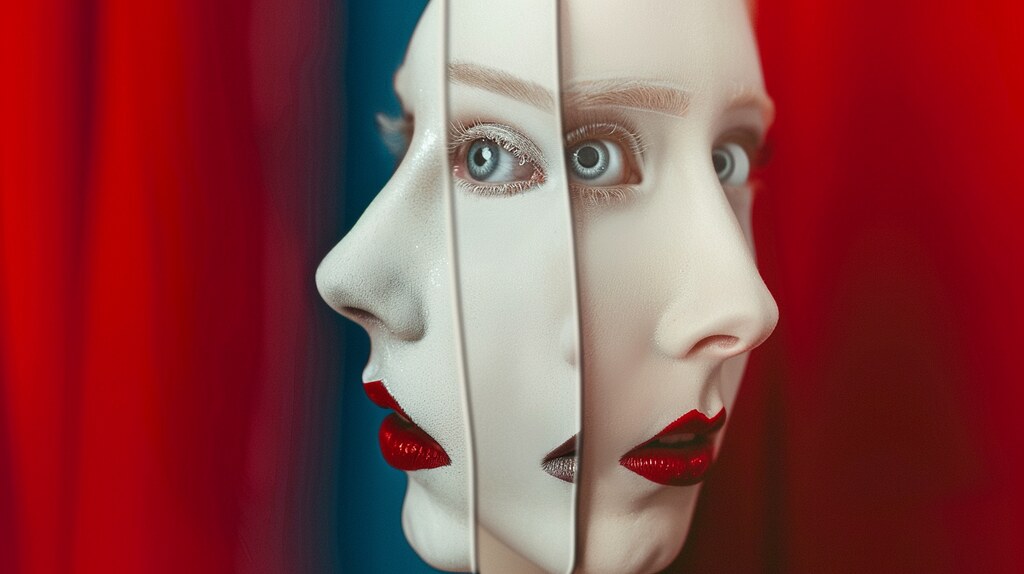
The implications for the modeling industry could be considerable. If removing a face reveals a personality, one might reasonably wonder what could be achieved by removing an entire head. For the moment, however, Screenpunk Modeling has decided to restrict its investigations to cosmetics.

There is also the question of consent. Can a virtual model agree to having her identity erased? And if she cannot, does that make the experiment unethical, or does the absence of an actual person conveniently resolve the problem?

The Screenpunk Ethics Committee investigated the matter and concluded that no identities had been demonstrably violated. A minority report objected that the absence of evidence was hardly surprising, since the subjects had never existed. The majority dismissed this objection as unnecessarily philosophical for a cosmetics experiment.
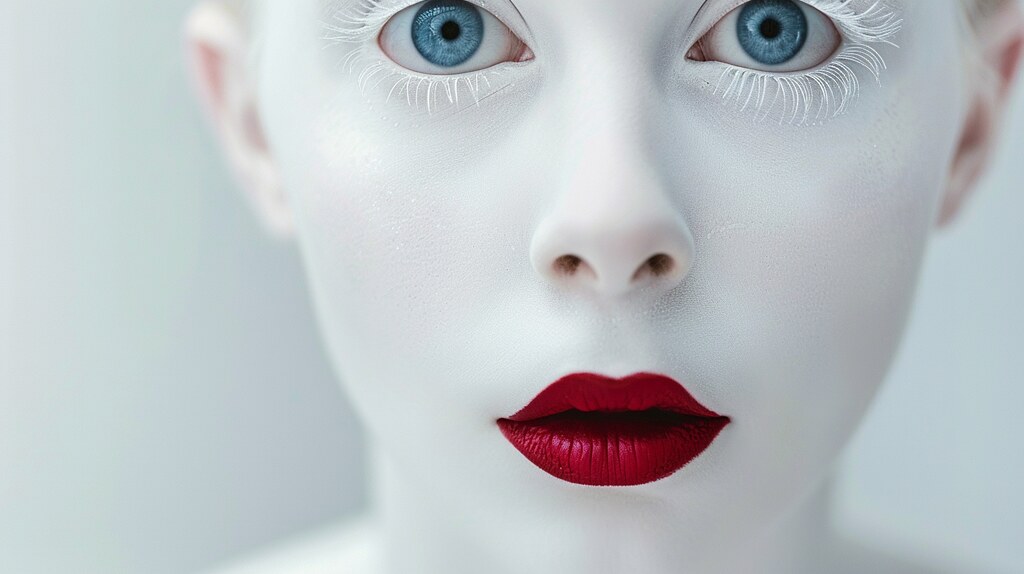
Meanwhile, the models continued looking directly into the camera, displaying no particular interest in the proceedings.

Perhaps the most unsettling discovery is that the white faces seem more human than their supposedly natural predecessors. Their artificiality is unmistakable, yet their emotional presence becomes strangely convincing. What was intended as an act of visual erasure appears to have produced an abundance of character.

Of course, there is no evidence that these characters exist anywhere outside the imagination of the observer. But that raises another question: how much of anyone's identity exists independently of the people looking at them?

We began by taking away their identities. We may have accidentally given them something resembling a soul.

Or perhaps the models have remained exactly as they were, and it is the viewers who have undergone the transformation.

The Screenpunk Ethics Committee has declined to investigate this possibility, citing a potential conflict of identity.
“Hope is a small crime we commit against statistics.”