Text and images by Screenpunk in collaboration with various AI-agents. January 2025
On structures and patterns in image generation
As the use of patterns and structures seems to provide a promising direction for development of meaningful practices of image generation, a question that comes to mind is how structures and patterns differ from each other. ChatGPT compares the two as follows.
Structure
- Definition: Structure refers to the arrangement or organization of parts within a whole, emphasizing how these parts relate and support the overall function.
- Key Features:
- Framework: Structure provides the foundation or skeleton that holds things together.
- Function-Oriented: More focused on the relationships and roles of components.
- Hierarchy or Organization: Often includes elements like layers, systems, or levels.
- Examples:
- In architecture: A building's framework, including its beams and supports.
- In biology: The cellular structure of an organism.
- In writing: The logical organization of ideas in an essay (introduction, body, conclusion).

Pattern
- Definition: A pattern is a repeated or recurring arrangement of elements, such as shapes, colors, sounds, or actions.
- Key Features:
- Repetition: Patterns rely on repetition or regularity.
- Design-Oriented: Commonly used in textiles, visuals, music, and mathematics.
- Predictability: Patterns often follow a recognizable or logical sequence.
- Examples:
- In design: A floral pattern on wallpaper.
- In nature: The spots on a leopard or the symmetry of a snowflake.
- In behavior: A predictable series of events, like daily routines.

Patterns and Structures
From ChatGPT's description a visual structure can be comprehended as a large entity composed of other, smaller entities. A pattern can be understood as the way these smaller entities are layed out in it's compounding body.
Image#3 shows a large structure that encompasses a pattern that consists of smaller dots. The structure can also be grasped as a compound structure, that consists out of three similar structures (one yellow, two black), that all have comparable patterns.

A patterned structure as hairdo on a silhouette figure
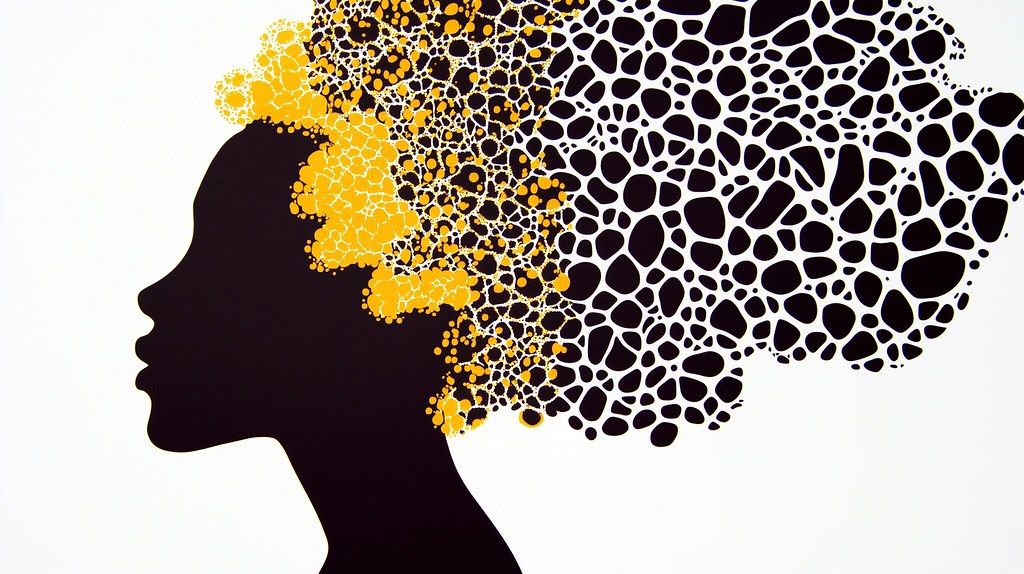
In image#4 a compound, patterned structure is placed upon the silhouette of a figure as an extensive hairdo. The hairdo resembles the patterned structure from image#3, but it differs in that it embodies an inversion. The pattern cells are now colored and the structure, that holds the patterns, has turned transparent.
The silhouette figure can be considerred a segment of the compound structure. This new segment is not patterned, but has a solid, black color.

Pattern variation
In image#5 the patterns vary. The black cells towards the figure's head are getting smaller. And between the purely black and yellow segments there is a pattern of black cells with yellow borders. The variations surely enhance the dynamic of the image.

Cluttering cells and overlapping patterns
In image#6, in the yellow segment next to the head, the distance between cells is reduced. The cells start to clutter and make up for new cell shapes, that make up for a new kind of pattern.
Additional, between the purely yellow and the purely black patterned segments, there's a segment where patterns fade and overlap. The patterns seem to be layered on top of each other, granting depth to the image.
Layering and connecting
In the bottom image (as well as in this pages top image) pattern variation and layering between the segments are raised to a more intense level. An orange background structure, with a pattern that consists of lines and triangles, is added. The patterns in the hairdo segments - from left to right - turn into network patterns.
The image illustrates that when cells are connected, patterns transform into structures. Consequently, the image contains a structure in a structure, that grew out of a pattern.
Pattern and structure transformation
In regards to the transformation, it can be concluded that the distinction between structures and patterns - as set out in the beginning - does not hold. Over fading borders, cluttering cells and intercellular connections, patterns can grow into structures.
So what, then, is the difference between a pattern and a structure? The question can be asked again. Of interest for the continuity of Screenpunk's New-Artevisuality-Project, however, is the question how the dynamics of pattern and structure transformation can contribute to aesthetical pleasing images, not so much theory.
“The sacred is what survives our sarcasm.”