Text and images by Screenpunk in collaboration with various AI-agents. August 2025
Summer 2025 immersed in monomaniacal image generation. A course by Steve McDonald triggered me to use Midjourney Moodboards. It not only changed my understanding of how-to-image-generate, it also fueled my drive for realizing the new artevisuality.
When Midjourney released it's moodboards I was involved with creating style congruence on my own terms. In Pattern Variation I used patterns of dots and curves as integral image contructors. In Portraits for the Future I tried to combine pattern variation with the aesthetic overtones of Hilma af Klint.
When, at some point, I noticed limitations of the 7.0 release of Midjourney, I followed Steve's advice and started experimenting with moodboards. That instantly made clear that moodboards are the way to go when aiming for style congruence. It felt like my image generating qualities indeed arrived at, as Steve calls it, the next level.
Moodboards
Moodboards provide Midjourney functionality for setting up one's own images as a source for generation of new images. Moodboards provide the new images with styles, colors, composition, patterns, structures, character and other features of the source images. These features are not just simply duplicated. The new images are rendered over random features from the source images, which makes the outcomes largely unpredictable - depending on the specificity of the prompt -, but makes them surely harmonize. As such, my patterned-dots-and-curves-constructors and the Klint aesthetics could be deployed perfectly over moodboards.

Building on previous work
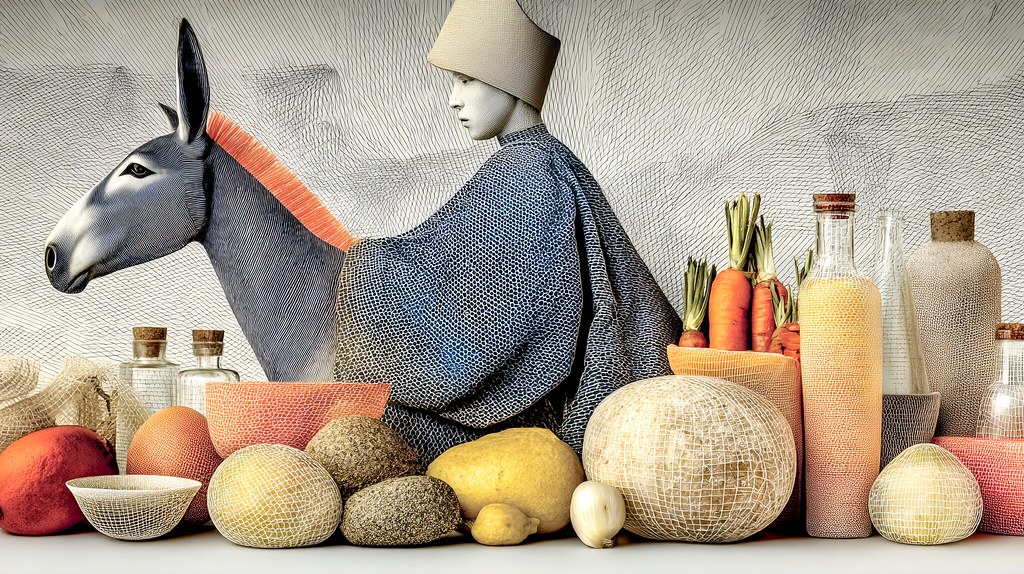
From Pattern Variation, Art for the Future, and a intermediary set called Carravagio in Tuscany, I embedded images in few moodboards and started generating images. With the new techniques, I felt like undergoing a Renaissant momentum and wrote prompts relating to Renaissance inspired themes. I applied the prompts in combination with the moodboards and experienced the beauty of style congruence and the possibilities for ongoing variation. This page features some of it results, a broader set is here.


After a while I used fresh images to create new moodboards and started applying them to new themes. From the resulting imagery I, again, created new moodboards, that I applied to new themes, that resulted in new imagery, that I ... and on and on and on.
The somewhat circular creation proces resulted in shifts of styles, that, when applied with different themes and moodboards, resulted in distinctive sets of imagery that all seem recognizable, as far as I can assess myself, as development of the Screenpunk style.


Distinct but related sets
Few sets that resulted from the monomaniacal drive for image generation are displayed on their own page.
New Urban Space shows neighbourhoods, streets, squares and other city area's that are generated in alignment with a moodboard that enables the output of clusters of appartments, houses and living cubes.
Post Modern Art Museum is an attempt to combine the clustering possibilities that were discoverd in the New Urban Space project with human figures.
Difficult Relationships explicetely steps into the surreal - an implicit ambition of Screenpunk's art development that fuels the monomania.
Monomania is inspired by Fiona Tan's enquiry into the history of pschychiatry and can be seen as a serie of chapters that demonstrates the versatility of the use of moodboards.
As for now, moodboards provide a solid step for further development of Screenpunk style of art generation. The outcomes build on previous projects of the use of patterns and structures as image constructors. And they seem to unfold the compository aesthetics from the Hilma af Klint experiments. The possibilities of moodboards, in combination with image embedding techniques, seem manifold. As such they seem to provide fuel for continuation of monomaniacal image genration.
“Gods retire; habits stay on payroll.”