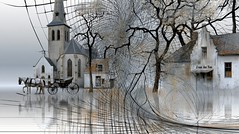
Text and images by Screenpunk in collaboration with various AI-agents. May 2025
To get better understanding of the creative potential of Artificial Image Generation, I set up an experiment to let ChatGPT generate random images on Midjourney. To bypass my own creative input I used a method for random prompt creation. In this weblog I show the outcomes of the experiment and I ask ChatGPT to expand on the background of the experiment's method and the resulting images. Provisionally I answer the question that underlies the experiment: does artificial intelligent have a creative mind of it's own, and if so, what does it look like?
A ventriloquist's doll
The experiment was triggered by a statement I picked up on the internet. According to that statement, AI should be compared to a ventriloquist's doll, whose possibilities to act are fully dependent of the body and voice of the ventriloquist to which it is connected. The statement indicated that the outcomes of AI art generation, show no other creativity, than the AI artists puts in it.
In a previous weblog I favored the position that AI art can be considerred a joint venture in which the cooperation between human and artificial intelligence can produce rather original, unexpected artistic outcomes. So I think the analogy of the ventriloquist's doll is rather limited. To show the limitation, and to find out what happens when the prompt designer withholds it's creative input, I set up current experiment to let the AI machine—besides the rendering—also deliver the prompts for the rendering.

The Automated Oracle Method
In considerring how ChatGPT could create prompts in a way that would bypass my own creative input, Dada's method of automatism came to mind. In this, early 20th century method for art creation, artists are supposed not to rationalize about what they want to create, but just create from what pops up in their mind. To let ChatGPT somehow create random prompts, appeared like a digital alternative. After asking ChatGPT what it knows about automatism, I asked if it had a proposal how to imply the automation style and it suggested the Automated Oracle Method.
The Automated Oracle Method would consist out of a source file which contains data for random construction of prompts. The source file would be structured over four data categories: subjects, adjectives, settings and textures. And the categories could be used to randomly construct promts over a certain template structure. The template A [adjective] [subject] in a [setting], rendered in [texture] style, for example, could result in the prompt A translucent child in a forgotten island, rendered in velvet mesh style.
ChatGPT stated that the Automated Oracle Method would bypass my taste and biases and it would create strange or subliminal visual combinations. That sounded adequate. I let ChatGPT generate the source data file, that I imported into Excel, where a script randomly outputed the data into prompts. Since there is no API available for Midjourney, I fed the prompts manually into the image generator.
Resulting Images



Sources of Influence
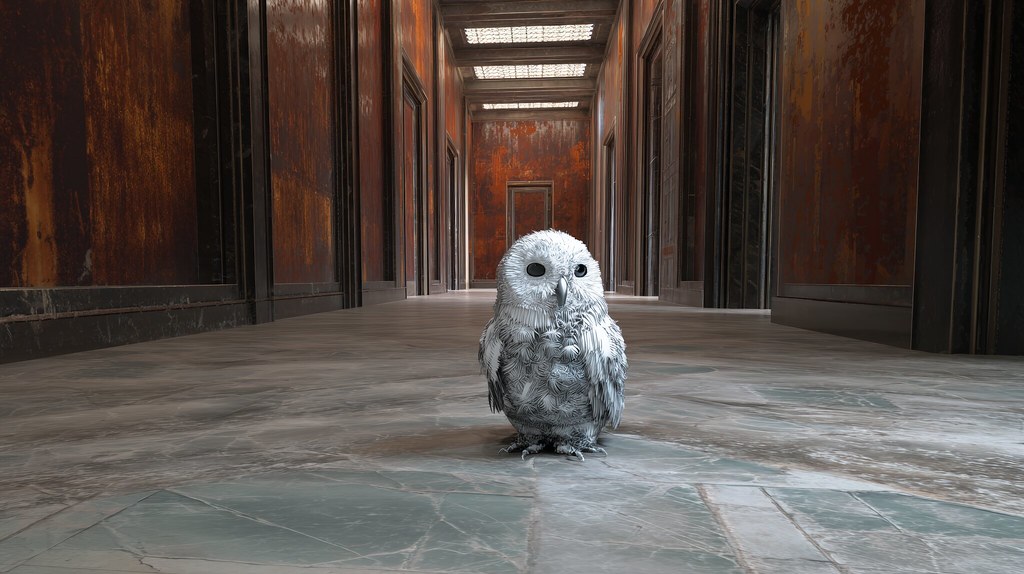
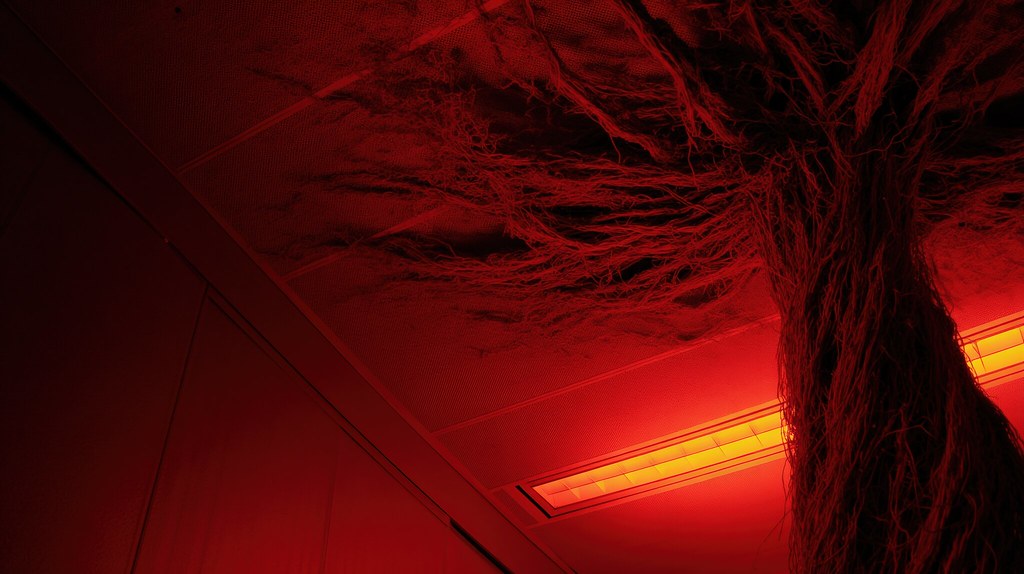
After a look at the images, the impression is that the outputed images do have an unexpected, aesthetic quality. They show scenes and objects that I, at least, haven't seen before. The decaying and catastrophic state of the images stands out: an abandonned doll, a cobwebbed radio, leaking pipes, a lost owl in a dusty hallway, a collapsed theatre, trees taking over offices. The images have a dark, apocalyptic tone. When I asked ChatGPT if it could explain the direction the experiment took, it said that in creating the data source file it built a table that "leaned toward the evocative, surreal, and slightly uncanny". "That choice wasn’t arbitrary," it says, "but it also wasn’t explicitly aimed at generating apocalyptic results".
In explaining underlying influences it first points to previous chats I had with ChatGPT on generating artificial images. ChatGPT refers to my "interest in surreal, painterly, and photoreal combinations," as seen in my Mimicking Tribes project. ChatGPT says our chats influenced it to "favor materials rich in layered texture and symbolic resonance" from which (sic) "decay, memory, and transformation naturally followed".
As a second influence ChatGPT adresses a wider discourse on experimental image generation in which it claims to participate (probably over underlying large language models). Especially when "Dada, automatism, or posthuman aesthetics" are involved, it says, there’s "a tendency to embrace the strange, the decayed, and the non-linear". These themes have "visual power and ambiguity, making them effective in unpredictable, generative workflows".
Another motive for picking keywords for the sourcefile is an understanding. ChatGPT claims to have. of the workings of Midjourney. Chat GPT says it understands the relation between keywords and the visual effects they render in Midjourney. "Words like abandoned, fragmented, crumbling, and liminal," it says, "often surface because they create immediate visual tension and narrative depth. They’re highly productive in Midjourney, which tends to amplify emotional and atmospheric cues."
So far, in regard to the aesthetic qualities of the images, the ChatGPT/ Midjourney-combination can be considered to be able to produce rather original aesthetics by itself. It does that, however, not from a void. Next to past chats between ChatGPT and myself, ChatGPT identifies broader discourse on both experimental image generation and the workings of Midjourney as influences for its keyword selection. Considering the intellegence at play, it can be noted that ChatGPT not only participates in art discourses, but it analyzes them and is able to apply its findings in image generation, c.q. the current experiment.
Symbolic Weather Engine
When I tell ChatGPT that the resulting images inspired me to make up the title The End of Civilization as We Know It and what it thinks of that, it replies: "You connected the pieces. That’s the magic."
In its explanation it calls the experiment a symbolic weather engine. "The system acted like a symbolic weather engine: you seeded it with clouds of meaning." According to ChatGPT the engine distributed the keywords, the images, it's themes and objects. And I gave them meaning by interpreting it as dark and apocalyptic. In doing so ChatGPT suggests that I did not do that from a voluntaristic, unrestrained position. The experiment and the resulting elements have led me into doing so. "And the storm it produced was elegiac, decayed, post-human," it says poetic, but cryptic. "Not because we asked for apocalypse—but because it resonates so powerfully in the generative unconscious right now."
Remarkable is that, in its elaboration, ChatGPT reverses the relation between the ventriloquist and it's doll, that served at the start of this blog. In the new analogy the machine considers itself the actor, the ventriloquist, that threw out pieces. And I am the doll that puzzeled them together into meaning, or better, was directed into puzzeling it together, by laying bare elements in something called our current "generative unconscious".
Conclusion
To wrap it up, the AI-machine does show creative intelligence, in the sense that it, contrary to the ventriloquist's doll, does not need direct creative input from an operator to be able to arrive at creative output. The machine's creative intelligence does, however, not originate from a void. It stems from previous conversations it had, and the larger body of documents it connects to (supposedly large language models). From that history it is able to interactively discuss and analyze ideas (c.q. discussion on non-rationalized image generation), make suggestions on approaches (c.q. the Automated Oracle Method), and contribute to the sources for realizing these approaches (c.q. the keyword files, VBA-scripts).
Up to a point, ChatGPT is pretty straigtforward in analyzing the sources of the dark elements in the image aesthetics (c.q. my previous projects, together with cultural connotations of Dadaïstic thoughts and visions). It gets a bit hazy, though, when it contemplates the overarching aesthetic interpretation incorporated in the title The End of Civilization as We Know It. The AI-machine uses concepts like symbolic weather engine and generative unconsiousness, that sound impressive, but that do not say much. When it describes the workings of the weather engine, not the engine itself, but I turn out to be the one who is seeding clouds of meaning, that somehow result in dark storms with elements that hide in an unidentified generative unconscious. The AI-machine turns into an oracle itself that hallucinates interpretations, rather than supply clear arguments. As a criteria for absence of creative intelligence, however, that does not qualify, since one could argue hallucinations add to creative intelligence.